
Many parents come to us with complaints of misaligned teeth in their child. They think it is just a tooth misalignment problem.
But it is not true in every case. Sometimes this issue may relate to tongue movement.
But how does tongue movement affect your child’s teeth?
Some signs are easy to miss in everyday life, such as your child finding it difficult to stick out their tongue or lift it towards the roof of their mouth.
But did you know that these restricted tongue movements in your child can affect how their jaw develops, mouth breathing, and some airway-related problems?
So, let’s understand how tongue-tie and jaw development are linked, and its treatment options.
What Is Tongue Tie in Children? Understanding Ankyloglossia
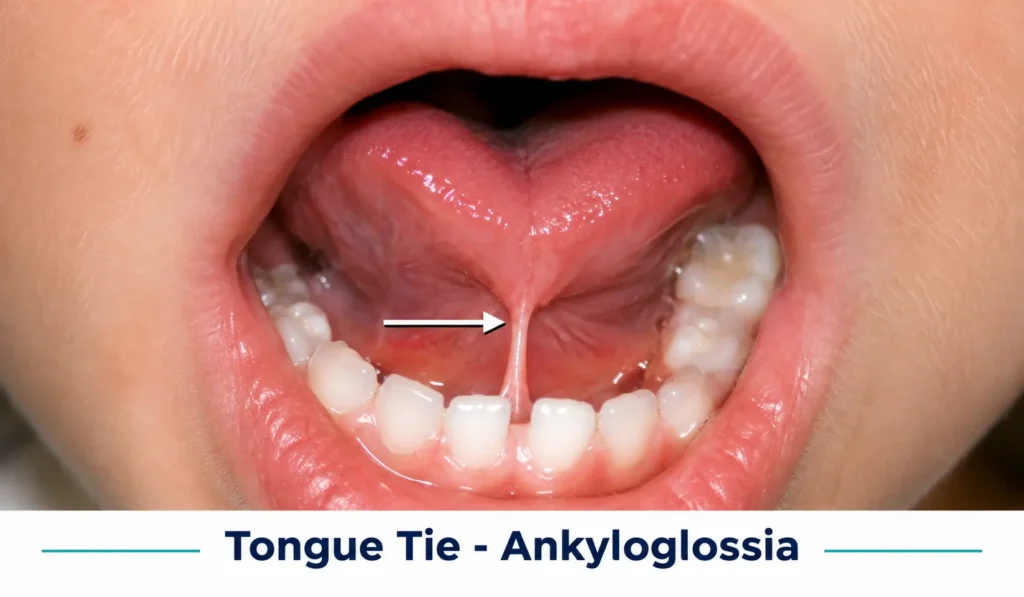
Tongue-tie, or ankyloglossia, is a condition in a child that is present from birth. In tongue-tie, when the lingual frenum is too short or too long, your child can not move the tongue freely.
But what is the lingual frenum? A small band of tissue on the floor of your child’s tongue, called the lingual frenum.
Tongue Tie Types: Anterior and Posterior
Tongue-tie has two types based on where the lingual frenum is attached:
- Anterior Tongue-Tie: The lingual frenum attaches near the front or tip side of your child’s tongue.
- Posterior Tongue-Tie: The lingual frenulum attaches to the back and base side of your child’s tongue.
How the Tongue Shapes Jaw Development in Childrens
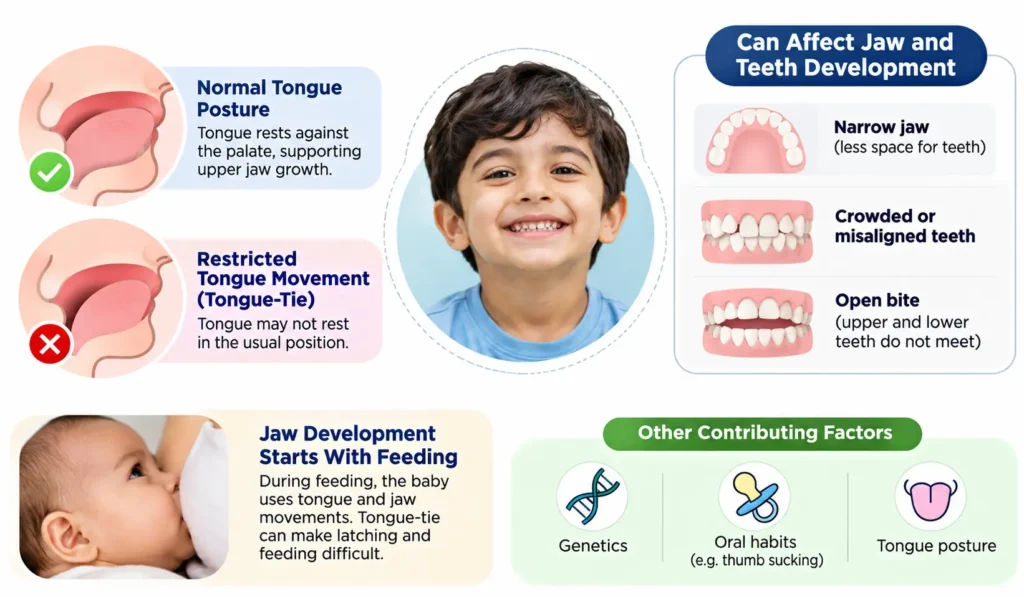
The tongue plays an important role in speaking, eating and the development of teeth and jaws.
Tongue Posture and Upper Jaw Growth
Normally, when your child closes their mouth, the tongue is placed against the palate. This supports normal oral functions and upper jaw development. But when your child has affected tongue movement due to tongue-tie, the tongue may not rest in its usual position.
Poor Jaw Development, Crowded Teeth and Open Bite
If your child has a narrow jaw or poor jaw development, there is not enough space to place teeth. This can lead to crowded or misaligned teeth. Sometimes, an open bite can occur if the upper and lower teeth can not meet properly when your child closes their mouth.
Jaw misalignment in children often shows up first as crowding or a bite that does not close properly.
Factors such as genetics, oral habits, and tongue posture can cause these problems. Tongue-tie is one of these factors, but it is not the only cause.
Habits such as thumb sucking during childhood can also influence the development of the teeth and bite, sometimes contributing to incomplete bites.
A narrow upper jaw can also affect the available space for teeth and contribute to bite-related problems in growing children.
Baby Jaw Development Starts With Feeding
Your baby’s jaw development starts when they start feeding. During feeding, your baby uses tongue and jaw movements. If your baby has tongue-tie, they may not latch and feed properly.
Tongue Tie, Mouth Breathing in Children and the Airway
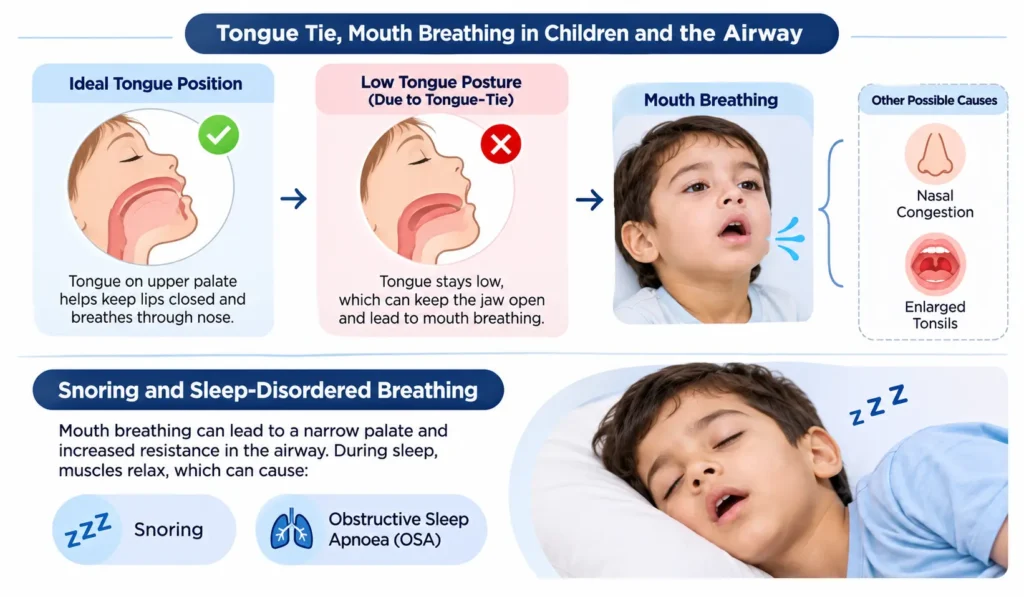
Tongue-tie not only affects your normal function of the mouth but may also affect breathing problems too. Let’s understand it.
Why Low Tongue Posture May Be Linked to Mouth Breathing
Ideally, when your baby closes their mouth, the tongue is placed on the upper palate, which can keep your baby’s lips closed and force air through the nose.
But low tongue posture means your baby’s tongue is placed below the base of the mouth due to tongue-tie. So, your baby’s jaw remains open and causes chronic mouth breathing.
Sometimes, this connection works both ways. Nasal congestion or enlarged tonsils may make nose breathing difficult, so your baby starts breathing through the mouth; this may change the resting position of the tongue.
When mouth breathing continues for years, it can also change how the face grows, a pattern known as adenoid facies.
Snoring and Sleep-Disordered Breathing
Changes in relation to tongue-tie with oral function and breathing problems can lead to sleep-related problems. Frequent mouth breathing in children may cause a narrow palate and increase resistance to airflow through the nose.
During sleep, muscles around the airway become relaxed and make it harder to breathe freely. This can cause snoring or obstructive sleep apnoea (OSA).
A 2024 review claimed that children with a short lingual frenulum have three times higher chances of developing OSA.
Sleep-disordered breathing ranges from mild, habitual snoring to OSA, so it is worth checking early in growing children.
Signs of Tongue Tie in Toddlers and Older Children
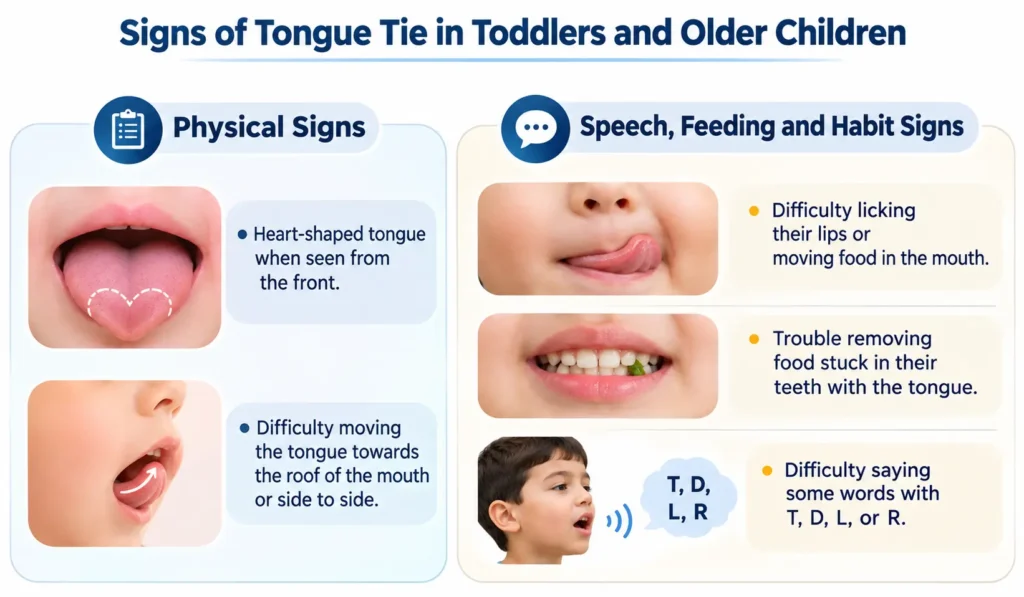
Here are some signs that you notice in your child:
Heart-Shaped Tongue and Other Physical Signs
- When you see from the front, the tip of your baby’s tongue looks heart-shaped.
- Also, you may notice your baby has difficulty moving the tongue towards the roof of the mouth or side to side.
Speech, Feeding and Habit signs
- Your baby may find it difficult to lick their lips or move food in their mouth.
- Also, they face difficulty removing food stuck in their teeth with their tongue.
- Your baby has trouble saying some words with T, D, L, or R.
Crooked teeth can also cause speech disturbance, so it helps to check both the tongue and the teeth.
Does Tongue Tie Need Surgery?
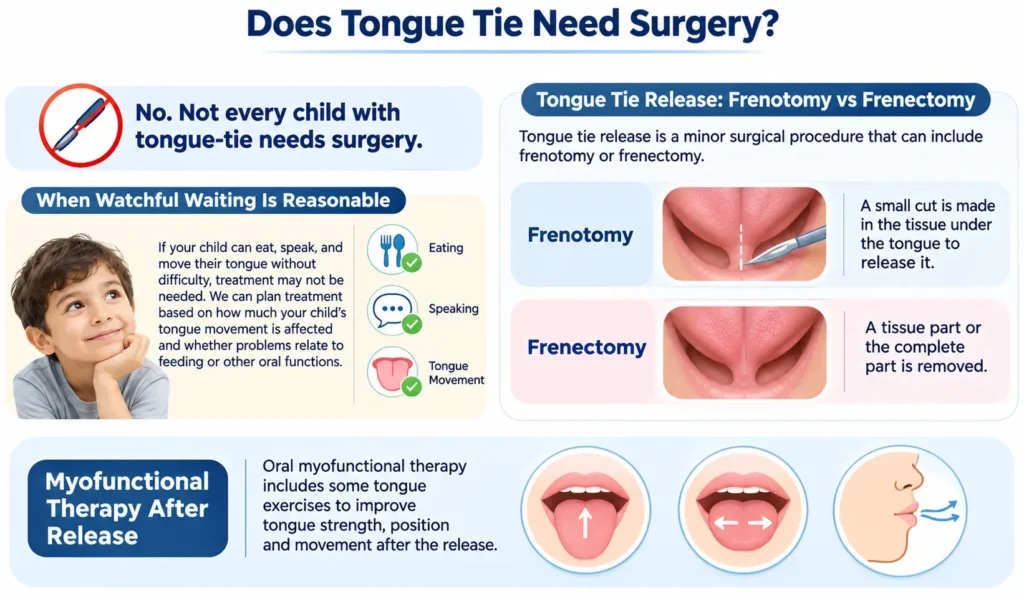
No. Not every child with tongue-tie needs surgery.
When Watchful Waiting Is Reasonable
If your child can eat, speak, and move their tongue without difficulty, treatment may not be needed. We can plan treatment based on how much your child’s tongue movement is affected and whether problems relate to feeding or other oral functions.
Tongue Tie Release: Frenotomy vs Frenectomy
Tongue tie release is a minor surgical procedure that can include frenotomy or frenectomy.
| Procedure | What it means |
| Frenotomy | A small cut is made in the tissue under the tongue to release it. |
| Frenectomy | A tissue part or the complete part is removed |
Myofunctional Therapy After Release
Oral myofunctional therapy includes some tongue exercises. These exercises improve your child’s tongue movement and oral muscle coordination.
Some children also need tongue thrust exercises if the tongue pushes against the teeth while swallowing.
Why Early Orthodontic Assessment for Children Matters
Early orthodontic assessment is important in growing years to check for any crowded teeth, a narrow palate and bite problems because these are still developing in your child.
If a narrow palate is found, a palatal expander can widen the upper jaw gradually while your child is still growing.
Orthodontics focuses on correcting teeth alignment and bite problems while considering the relationship between the upper and lower jaws.
Your orthodontist looks at your child’s teeth, jaw development, and tongue movement. Airway orthodontics may be considered when your child has jaw development and breathing issues.
The choice of orthodontic treatment depends on the child’s dental development, bite condition and individual orthodontic needs.
Based on the diagnosis, they may refer your child to an ENT specialist or speech therapist for further checks. This can identify problems early and treat them at the right time.
Final thoughts: Supporting Your Child’s Dental Health at Fort Dental Clinic, South Mumbai

Every child’s growth is different. Small changes in your child’s tongue movement, teeth alignment, or breathing can sometimes not be noticed easily. If you notice these signs early, please visit your nearby dental clinic.
At Fort Dental Clinic in South Mumbai, Dr Arun Nayak helps to assess the growth and development of your child’s teeth & jaws.You can simply talk about any concerns with Dr Nayak, and he guides you on the next steps to support your child’s oral health.
FAQs
It can be one of the contributing factors. A narrow jaw leaves less room for teeth, which can lead to crowding. An open bite can develop when the upper and lower teeth do not meet properly. Thumb sucking and genetics are also common causes, so an orthodontic assessment is needed to find the actual reason.
Look for difficulty lifting the tongue towards the roof of the mouth, moving it side to side, or sticking it out. Other signs include a heart-shaped tongue tip, trouble licking the lips, and trouble pronouncing T, D, L or R sounds. Feeding difficulty in babies is another sign.
The procedure is quick, and discomfort is usually mild. Older children are often treated with local anaesthesia. Your doctor will explain the aftercare and what to expect during healing.
A paediatrician or orthodontist can do the first assessment. Depending on what they find, they may refer your child to an ENT specialist or a speech therapist. An orthodontist can also check how tongue movement relates to your child’s jaw and bite development.
Tongue-tie may affect tongue mobility and resting posture, which are important aspects of oral function. However, there is limited evidence that tongue-tie directly changes facial shape. Facial development is influenced by several factors, including genetics, jaw growth and breathing patterns.
A heart-shaped tongue tip when the child tries to extend the tongue can be a visible sign of restricted tongue movement. However, this appearance alone is not enough to confirm tongue-tie. A professional assessment of tongue mobility and function is necessary.

BDS, MDS – Orthodontics & Dentofacial Orthopaedics
Chief Orthodontist, Fort Dental Clinic, Mumbai
Dr. Arun Nayak is a leading orthodontist in Mumbai with 20+ years of experience in braces, aligners, and advanced bite correction. As the founder of Fort Dental Clinic, he is known for delivering personalized, technology-driven orthodontic care with a focus on precision and patient comfort.