
Tongue problems are rarely discussed in daily life. People usually think the tongue only helps with taste and speech. As an orthodontist, I see how tongue habits silently damage teeth and jaws. One such habit called tongue thrusting which affects children and adults alike. It slowly changes smiles and facial balance..
To understand how to stop tongue thrusting and why tongue thrust exercises for adults is necessary, as the best dental clinic, we are sharing some dental facts for your ease.
What Is Tongue Thrust?
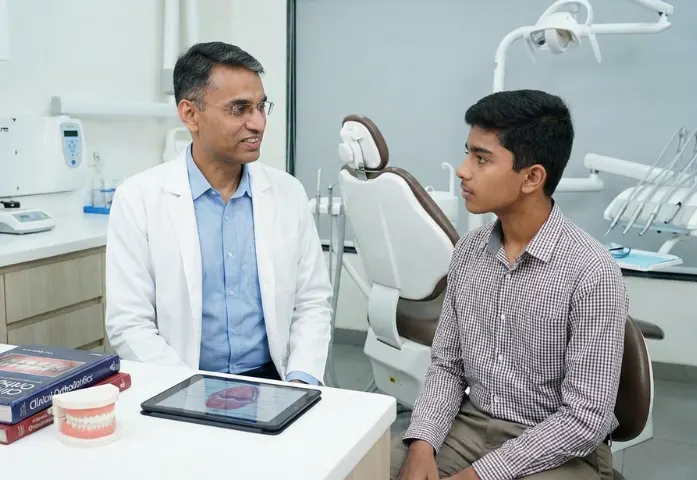
Many patients ask, what is tongue thrust during their first dental visit. It is a condition where the tongue pushes forward against the teeth while swallowing or speaking. Instead of resting gently on the palate, it presses between or against teeth. This forward tongue posture is medically classified under orofacial myofunctional disorder (OMD). This condition often contributes to malocclusion and can gradually lead to crooked teeth and bite problems if left untreated over time.
Studies show nearly 30–40% of children show some form of this habit. Research confirms that untreated tongue habits increase malocclusion risk by almost two times. But many still adults may continue it unknowingly into later life.
How Does Malocclusion Develop
Malocclusion develops when constant muscle pressure alters natural tooth position. The tongue is a powerful muscle. When it pushes forward repeatedly, teeth respond slowly but permanently. Front teeth drift outward. Back teeth may fail to meet properly. This imbalance affects chewing efficiency and jaw comfort.
Children are especially vulnerable during growth years. Long-term pressure can undo years of brace treatment. This is one of the most common reasons behind orthodontic relapse, where teeth slowly shift back to their original position if tongue habits and muscle pressure are not corrected in time.
Without correcting muscle behavior, alignment remains unstable. That is why dentists treat function along with tooth movement for lasting bite correction and stable oral health outcomes overall.
Usual Causes of Tongue Thrusting
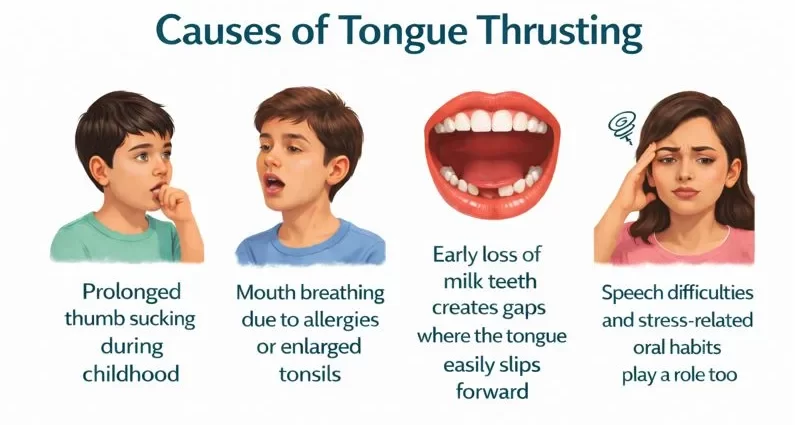
Tongue thrusting rarely starts without a reason. Prolonged thumb sucking during childhood is one of the leading causes. These thumb sucking habits can gradually change tongue posture and jaw development, increasing the chances of bite problems and forward tongue placement over time.
Mouth breathing due to allergies or enlarged tonsils also changes tongue posture training naturally. Early loss of milk teeth creates gaps where the tongue easily slips forward. Speech difficulties and stress-related oral habits play a role too.
Research shows that untreated nasal obstruction increases tongue thrust risk by almost 50%. Adults may develop it after dental extractions or poorly fitted braces.
Signs of Tongue Thrust You Should Not Ignore
Recognizing these early can save years of dental correction. Teeth that do not touch properly during biting are a common clue. Speech sounds like “s” and “z” may appear distorted.
Patients often complain of jaw fatigue as well as difficulty in swallowing. Visible gaps between front teeth are frequent. These gaps in teeth often develop due to constant tongue pressure on the front teeth, slowly pushing them apart and affecting overall smile alignment.
To look for other signs of tongue thrust, orthodontist also observe tongue protrusion during swallow or speech. Studies indicate that untreated cases significantly increase orthodontic relapse rates later.
How to Stop Tongue Thrusting
The first step is awareness. Learning the correct tongue resting position makes a major difference. Habit interception works best when started early but is effective even in adults. Breathing through the nose helps reset natural muscle balance.
Myofunctional exercises strengthen weak oral muscles – but these need to be under the supervision of trained dental professionals. Orofacial myofunctional therapy (OMT) shows success rates above 70% when followed consistently.
dewIn severe cases, dental appliances support correction gently and safely. In such situations, professional orthodontic treatment options, including modern solutions like Invisalign treatment, help guide teeth and tongue posture into the correct position for long-term stability – as the ideal answer to how to stop tongue thrusting.
Best Tongue Thrust Exercises for Correction
The 4S exercise: Spot, Salivate, Squeeze, and Swallow, is a myofunctional therapy technique in dentistry used to correct tongue thrust habits, improper swallowing, and associated anterior open bites.
It involves placing the tongue tip on the “spot” (palatal rugae area), salivating, squeezing the tongue against the palate with teeth closed, and swallowing while holding this position, typically practiced 40 times daily to encourage correct tongue posture.
Key Components of the 4S Exercise
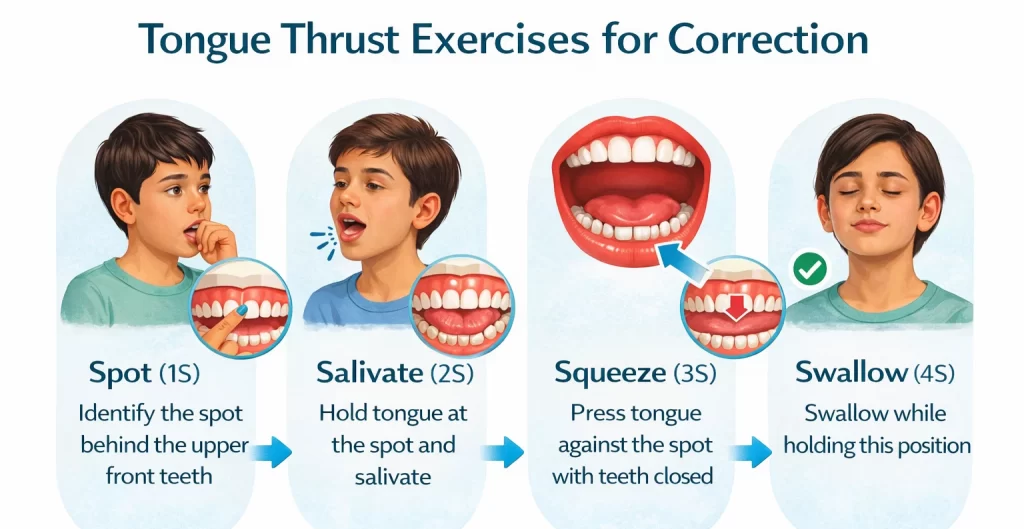
- Spot (1S): The child identifies the “spot” behind the upper front teeth (palatal rugae area) as the resting place for the tongue tip.
- Salivate (2S): The tongue is held at the spot to induce salivation.
- Squeeze (3S): The tongue is squeezed vigorously against the spot with the teeth closed.
- Swallow (4S): The child swallows while maintaining the tongue at the spot and teeth together.
These exercises become even more effective when supported by early orthodontic treatment, as correcting muscle habits during growth helps prevent long-term bite problems and improves overall alignment stability.
Well-planned tongue thrust exercises are the foundation of long-term correction. These exercises retrain muscles, not just the teeth. For example: simple method is the “spot exercise.” Place the tongue tip on the small ridge behind upper front teeth and hold for ten seconds. Repeat this ten times daily.
Another effective drill is saliva swallow training. Keep lips closed, teeth lightly together. Then swallow without pushing the tongue forward. This corrects atypical swallow patterns gradually.
For strengthening, press the tongue firmly against the palate. Then, hold for five seconds to improve muscle tone and posture. Button pull exercises help children and adults build lip strength, reducing tongue pressure on teeth. These methods are part of structured myofunctional exercises programs worldwide.
For adults, consistency of tongue thrusting exercises matters more than the intensity. These must be slow and retraining rather than force. Practising mirror swallowing improves awareness. Counting aloud while keeping the tongue stable reduces speech-related thrust.
Studies from orthodontic journals show patients who practice daily reduce relapse risk by nearly 60%. For lasting results, dental supervision under ace dental clinics like Fort Dental Clinic, Mumbai, assures safety and lasting results.
Why Choose Fort Dental Clinic for Fixing Malocclusion
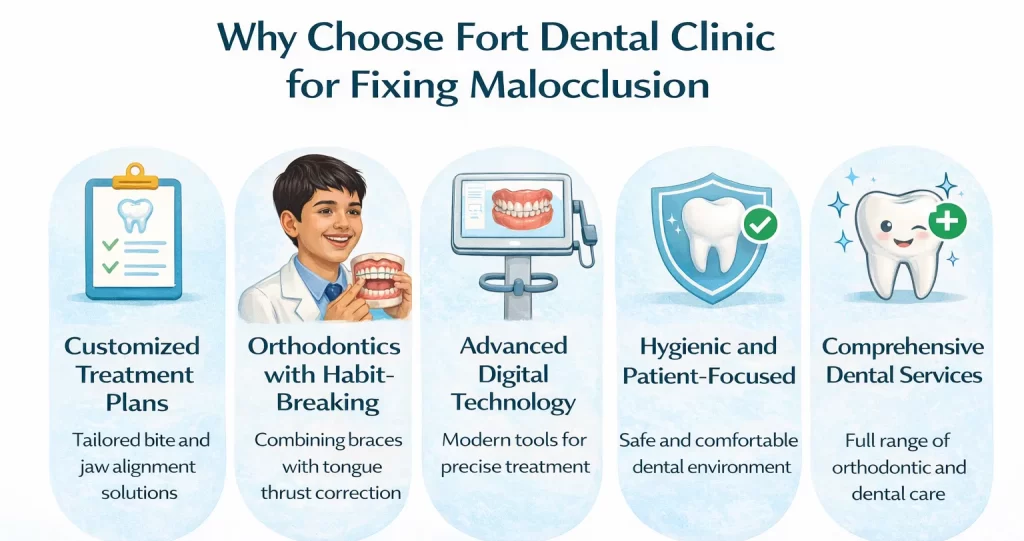
At Fort Dental Clinic, Mumbai, our approach focuses on correcting the root cause of bite problems with guidance from our orthodontic specialists Dr. Arun Nayak, ensuring long-term functional and aesthetic results.
- Customised treatment plan for bite and jaw alignment
- We will give you a detailed plan post-fixing for tongue thrust exercises for adults as well as children.
- We combine orthodontics with habit-breaking techniques for stable results
- Advanced digital orthodontic technology
- Hygienic, patient-focused clinical environment
- Comprehensive orthodontic plus dental services
Still Worried? Connect with Fort Dental Today
Tongue habits quietly shape your smile as well as your jaw health. Early oral issues detection and simple corrections will always keep you away from future dental problems. When Fort Dental guides you for therapy, exercises and expert care, you will always experience lasting improvement at any age.
Fort Dental Clinic, Mumbai offers experience-backed solutions that restore balance naturally. Correcting the habit today protects your smile for life tomorrow.
FAQs
Tongue thrust can often be improved naturally through myofunctional exercises, correct tongue resting posture, and nasal breathing. Simple practices like keeping the tongue on the palate, avoiding mouth breathing, and daily swallowing exercises help retrain tongue muscles. However, consistency and professional guidance improve long-term results.
Yes, tongue thrusting can be reversed in both children and adults. Treatment may include tongue thrust exercises, myofunctional therapy, orthodontic treatment, or habit-breaking appliances, depending on severity and age.
Yes, tongue thrust exercises work when done consistently and correctly. Research shows that myofunctional therapy strengthens tongue muscles, improves swallowing patterns, and reduces orthodontic relapse when followed under professional supervision.
Absolutely. Adults can successfully correct tongue thrust through myofunctional therapy, orthodontic treatment, and conscious habit correction. While adults may take longer than children, results are achievable with regular practice and guidance.
Tongue thrust is treated by a multidisciplinary team, which may include an orthodontist, dentist, and orofacial myofunctional therapist or speech-language pathologist.

BDS, MDS – Orthodontics & Dentofacial Orthopaedics
Chief Orthodontist, Fort Dental Clinic, Mumbai
Dr. Arun Nayak is a leading orthodontist in Mumbai with 20+ years of experience in braces, aligners, and advanced bite correction. As the founder of Fort Dental Clinic, he is known for delivering personalized, technology-driven orthodontic care with a focus on precision and patient comfort.