Have you ever noticed that your child struggles while chewing food or speaks unclearly? These small signs are easy to miss, but they can be related to how your child’s jaw is growing.
A child’s jaw does not grow at the same rate; it changes slowly over the years. When this process is not balanced, it can lead to jaw misalignment.
It is important to know what jaw misalignment in children is and how it can affect chewing, speech, and facial growth. If not identified early, it can lead to long-term issues.
Understanding the early signs and knowing the role of an orthodontist can help provide timely care and support healthy jaw development for your child.
To understand how early care works, you can read more about early orthodontic treatment for children.
What Is Jaw Misalignment in Children?

Jaw misalignment in children means that the upper and lower jaws do not fit together when your child bites or closes their mouth. This may be due to improper jaw growth, which can affect how the jaws align and function.
Normally, a child’s jaw develops so that the upper jaw is slightly ahead of the lower jaw, which helps in proper function.
However, many parents confuse jaw misalignment with misaligned teeth (malocclusion). It is important to understand that jaw misalignment is a skeletal problem, whereas malocclusion relates to the position of the teeth.
Jaw misalignment involves either one jaw or both jaws. Sometimes children have a normal tooth position but still have an underlying jaw issue.
Why Jaw Growth Matters in Children
Jaw growth is important for your child’s overall development, as it supports both function and facial appearance. When the jaws develop correctly, your children can perform everyday activities easily, including:
- Your child chews food better
- The child speaks clearly
- Healthy breathing patterns support your child’s growth
- Facial symmetrical balance keeps your child’s smile natural
- Enough space for your child’s permanent teeth, which reduces crowding
These functional issues are often linked to bite problems such as crooked teeth and speech disturbances.
But how do you know if your child’s jaw development needs attention?
5 Signs Your Child’s Jaw Is Not Growing Properly
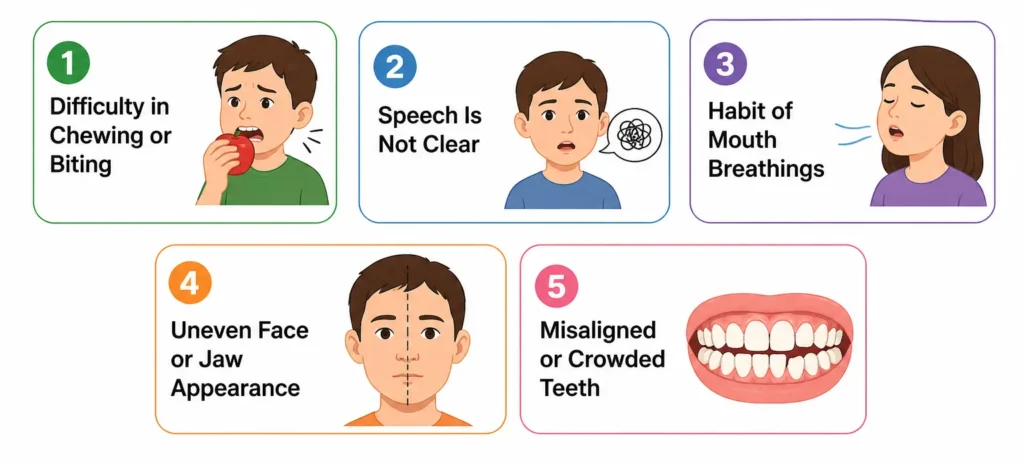
Jaw growth issues in children can be hard to spot early, but there are signs that can help parents identify if something is not developing as it should.
1. Difficulty in Chewing or Biting
If your child avoids certain foods, chews only on one side, or looks uncomfortable while eating, it may be because their jaw is misaligned. Over time, this can affect digestion and overall nutrition.
2. Speech Is Not Clear
Jaw development plays a big role in how children form sounds. If your child has a lisp (difficulty saying “s” and “z” sounds clearly), unclear pronunciation, or trouble saying some words may be linked to jaw positioning rather than just a speech delay.
3. Habit of Mouth Breathings
If your child regularly breathes through their mouth rather than their nose during sleep, it can affect the development of the jaws and face. This habit may lead to a longer face shape or misaligned jaws.
Habits like this are often linked with tongue thrust patterns, which can gradually affect jaw alignment.
4. Uneven Face or Jaw Appearance
You may notice that one side of your child’s face looks slightly different or uneven. In some cases, the jaw may shift to one side when opening or closing the mouth. These are signs that the jaws may not be growing properly.
5. Misaligned or Crowded Teeth
Your child’s teeth can show how the jaw is growing. If there is not enough space, the teeth may look crowded, overlap, or come in unevenly.
You might notice the top teeth are too forward (overbite), the bottom teeth come ahead(underbite), or the teeth do not fit properly(crossbite) when your child closes their mouth.
In many cases, conditions like crossbite of front teeth or spacing issues may also be present.
What Causes Jaw Growth Problems in Children?
The cause of jaw misalignment is impacted by natural growth patterns and childhood habits.
| Causes | How it impacts jaw growth |
| Genetic factors | Your child may inherit jaw size or shape from you, which can affect how their jaw grows |
| Thumb sucking (habit of putting thumb in mouth) | Long‑term thumb sucking can push teeth forward and change jaw growth |
| Prolonged pacifier use | Using a pacifier for too long may disturb normal jaw development and tooth alignment. |
| Tongue thrusting habits (tongue pushes against teeth) | Pushing the tongue forward can slowly shift teeth and jaw position |
| Early loss of milk teeth | Losing baby teeth too early reduces space, disrupts jaw growth, and crowds permanent teeth. |
Early loss of baby teeth can sometimes require intervention, as explained in milk teeth extraction cases.
Understanding these causes is the first step, but who can guide your child’s jaw growth in the right direction?
Role of an Orthodontist in Correcting Jaw Growth
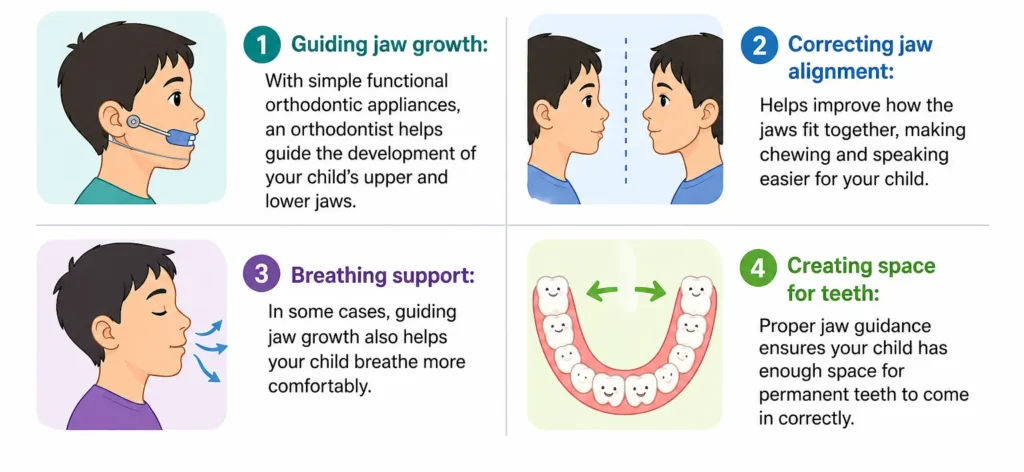
An orthodontist helps guide your child’s jaw growth in the right direction during their growing years. The following are the key roles of an orthodontist:
- Guiding jaw growth: With simple functional orthodontic appliances, an orthodontist helps guide the development of your child’s upper and lower jaws.
- Correcting jaw alignment: Helps improve how the jaws fit together, making chewing and speaking easier for your child.
- Breathing support. In some cases, guiding jaw growth also helps your child breathe more comfortably.
- Creating space for teeth: Proper jaw guidance ensures your child has enough space for permanent teeth to come in correctly.
- Improving facial balance: Healthy jaw growth supports your child’s natural, balanced facial look.
These approaches are part of modern orthodontic treatment options used during growth years.
When Should You Take Your Child to an Orthodontist?
Your child’s jaw continues to grow during the early years, especially between ages 7 and 13. This is the right time to notice if something is not developing properly.
Because of this, the American Association of Orthodontists recommends a first orthodontic check-up by age 7. At this stage, it is easier to guide your child’s jaw growth if needed.
A simple early check-up with the best orthodontics can help avoid bigger problems later and support your child’s healthy smile.
Early Treatment Options for Jaw Issues
When jaw concerns are found early, simple treatments can help guide healthy development during growing years.
| Treatment | How it helps |
| Palatal expander (Fixed/Removable) | Widens the upper jaw to create space for teeth |
| Functional appliance | Helps guide jaw growth and improve how the upper and lower jaws fit together |
| Braces | Corrects teeth alignment issues |
| Habit correction therapy | Helps stop habits that affect jaw growth |
Conclusion: Your Child’s Healthy Smile Starts Early

Small changes in a child’s eating, speech, or facial appearance can sometimes point to jaw growth concerns. Recognizing these early helps make care simpler and more effective. With the right guidance and timely support, your child’s jaw can develop in a healthy way.
At Fort Dental Clinic, an experienced orthodontist in Mumbai, is focused on early care that supports long-term comfort, function, and a confident smile.

BDS, MDS – Orthodontics & Dentofacial Orthopaedics
Chief Orthodontist, Fort Dental Clinic, Mumbai
Dr. Arun Nayak is a leading orthodontist in Mumbai with 20+ years of experience in braces, aligners, and advanced bite correction. As the founder of Fort Dental Clinic, he is known for delivering personalized, technology-driven orthodontic care with a focus on precision and patient comfort.