
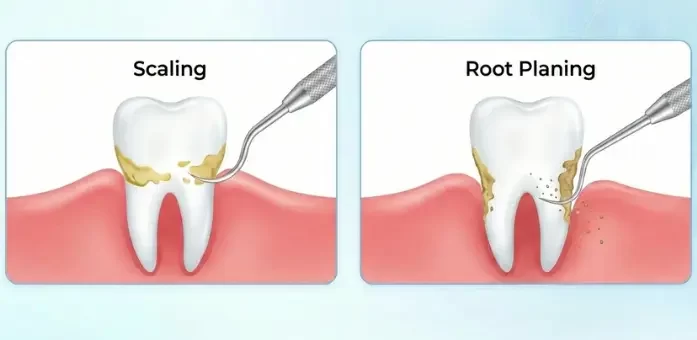
One of the most basic dental treatments, preventive and useful treatments would be teeth cleaning or dental scaling or oral prophylaxis. Despite brushing, plaque, calculus, tartar, and stains can accumulate on the teeth over time. If brushing is not carried out properly, then the accumulation of the same can be rapid. Professional dental hygiene prevention and treatment help remove these deposits effectively.
What is Scaling and Root Planing?
Many patients often ask what scaling and root planing is and how it is different from regular teeth cleaning. It is a deeper form of dental cleaning that is done below the gum line and not just on the visible surface of the teeth. Normal brushing cannot clean the areas where bacteria, food particles, and tartar collect deep inside the gums.
When food deposits, bacteria, and hard tartar stay inside the gum pockets (periodontal pockets), they can lead to infection, gum inflammation, and eventually gum disease. In such cases, tooth scaling and root planing helps remove these hidden deposits from beneath the gums and along the roots of the teeth.
In simple terms, this process is also known as deep cleaning or periodontal deep cleaning. It is a proven nonsurgical periodontal treatment used worldwide to help control infection, improve gum health, and save teeth affected by gum disease. The procedure is safe, effective, and designed to clean areas that regular brushing and routine cleaning cannot reach.
Signs you may need scaling and root planing
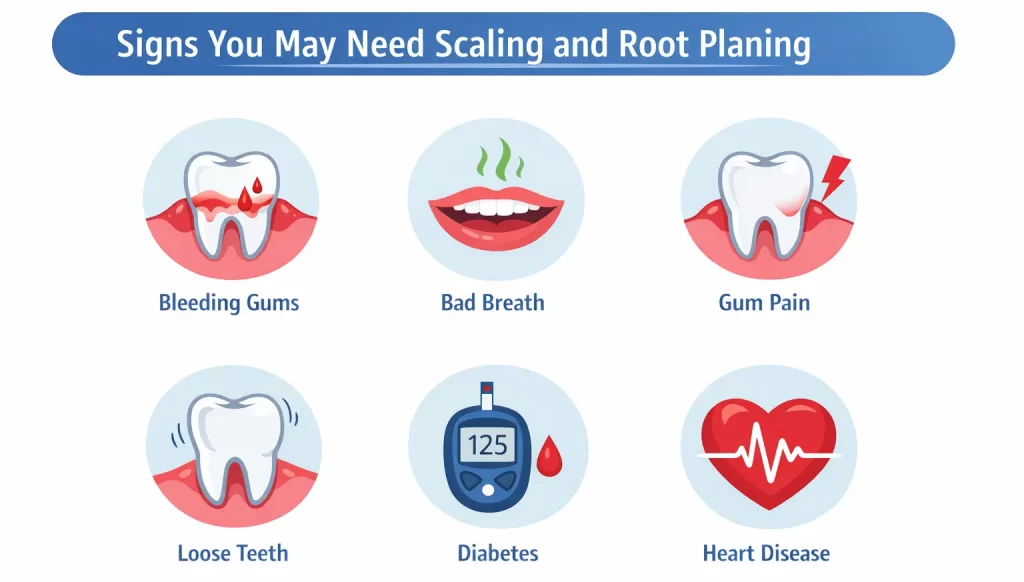
Bleeding gums
Patients with plaque and tartar might complain of bleeding gums. The cause is inflammation of the gums, which could be gingivitis and in extreme cases, periodontitis.
Halitosis
Patients complain of bad breath. Although there are many reasons for bad breath, the most common is tartar and plaque accumulation.
Gum pain
Tartar buildup can cause a dull ache in the gums, which gets alleviated once a cleaning is done
Mobile teeth
The cause of mobile teeth is generally periodontally weakened teeth. Plaque and tartar build-up can cause inflammation of the gums, leading to periodontitis which in turn affects the ability of the bone to hold the teeth
Patients with diabetes
Diabetes affects a lot of organs in the body, and one area is the periodontium. As a result, there could be a lot of bone loss if the gums are not healthy. It is therefore imperative to keep the teeth clean to avoid periodontal disease, which results in bone loss
Patients with heart conditions
Poor oral hygiene can act as a gateway for bacteria to enter the bloodstream, which in turn can affect the heart valves. To prevent the gums from being a source of bacteria, regular and timely scaling should be done.
How Often Should You Get Dental Scaling and Teeth Cleaning?
Scaling and root planing should be done at least once a year, if not twice. It depends on the patient’s ability to keep their teeth clean or the frequency of plaque build-up. However well a patient might brush their teeth, there are always some areas difficult to access, which leads to plaque build-up, which in turn leads to tartar formation
Teeth cleaning prevents dental cavities or caries. Typically, caries or cavities are caused by food buildup, which results in plaque buildup and then tartar buildup. Plaque build-up can result in cavity formation
Dental cleaning on time can prevent a whole lot of dental issues, which in turn means less dental work for the patient and less cost to the patient as well.
How is dental cleaning done?
Cleaning is done by using an ultrasonic scaler. With vibrations and water, it loosens the built-up tartar and, in turn, cleans the teeth. The teeth are not scraped. Only the dirt is removed from the teeth. The teeth are polished with a polishing paste post scaling so that the smooth surfaces do not attract fresh plaque easily. Dental polishing also removes all stains caused by tea, coffee, and smoking, thus giving the patient a clean and fresh smile.
For patients who are undergoing orthodontic treatment, it is imperative that they get regular cleaning, especially with conventional orthodontics and braces. Otherwise, plaque build-up can lead to unhealthy gums due to gingivitis.
Immediately after scaling, the teeth might feel a bit sensitive. And that is a normal reaction. Tartar had accumulated on the teeth. Now that the tooth has been cleaned, it is exposed. Once the gum reattaches, the sensitivity will disappear
The teeth feel odd after scaling esp. near the tongue. That is because now the tongue can feel each individual tooth, which earlier felt like one wall due to the tartar buildup.
Post scaling instructions
- There are no food restrictions
- Patient to rinse with warm water and salt twice a day for a couple of days
- To floss teeth esp. at night
- To massage gums with a gum paint like Gummex
- If gums are very unhealthy, take a course of Vitamin C for a month
Scaling should be done once a year or twice, depending on tartar buildup. Scaling is a great way to start dental treatment. It is a painless procedure, a necessary procedure and helps the patient to get comfortable with the dentist for further procedures.
Why Choose Fort Dental Clinic in Mumbai for Scaling and Root Planing
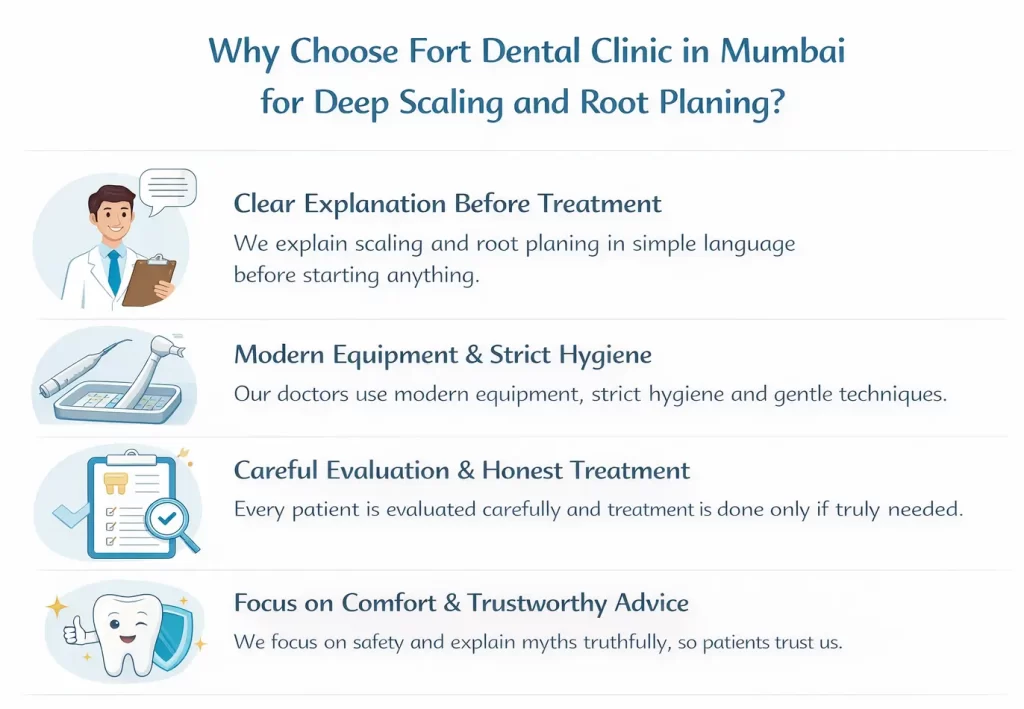
At Fort Dental Clinic in Mumbai, we treat patients with patience, honesty, and care. We understand dental fear, so we first explain what scaling and root planing is in simple language before starting any treatment.
Our doctors use modern equipment, maintain strict hygiene, and follow gentle techniques to ensure comfort and safety. Every patient is carefully evaluated, and tooth scaling and root planing is recommended only when truly needed for long-term gum health.
We also guide patients about deep scaling and root planing myths and facts without pressure. If you are still unsure or worried about pain, visit us. We listen first and then treat with care and respect.
FAQs
Normal cleaning works only on visible tooth surfaces. Dentists recommend deep cleaning when bacteria and tartar are present below the gum line, where brushing and routine cleaning cannot reach. This prevents further damage to gums and bone.
No. Scaling and root planing is usually pain-free. Patients may feel pressure, not pain. If gums are very sensitive, local anesthesia is used to keep the procedure comfortable.
It depends on gum health. Some patients need it once, while others with chronic gum disease may need periodic maintenance cleanings to keep infection under control.
Usually one or two visits, cleaning one side of the mouth at a time. Duration depends on the severity of gum disease.
The most common side effects are temporary sensitivity or mild gum soreness, which usually settle within a few days. Serious complications are rare when the procedure is done properly.